CN
Low-Temperature Brittleness Tester
Materials Testing Instrument

Low-Temperature Brittleness Precise, Reliable Testing

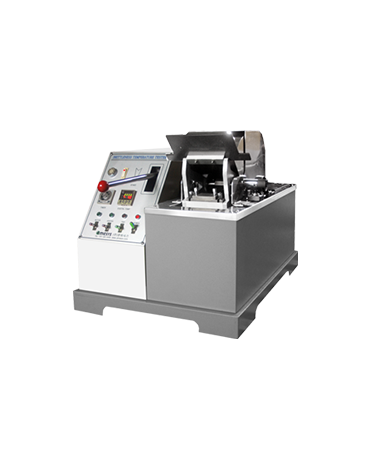
QM280B Low-Temperature Brittleness Tester

The QM280B low-temperature brittleness tester measures the physical limit at which plastics and rubber undergo brittle fracture when cooled; it determines the brittleness temperature (brittleness point) at which 50% of specimens fail.

Range -70 °C to room temperature, with digital PID control; specimens are cooled in a cryogenic medium and then fractured by an impact mechanism to evaluate the low-temperature toughness limit.

Detachable specimen fixtures make loading easy; an optional environmental chamber meets the requirements of ASTM D 746, ISO 812 and other standards.

-70°C ~ RT
50%-Failure Brittleness Point
Digital PID Temperature Control
Detachable Fixture
Optional Environmental Chamber
✓ Free Installation & Commissioning ✓ 1-Year Full-Machine Warranty ✓ Exported to 90+ Countries Worldwide
-70°C ~ RT Temperature Range
50% Failure Brittleness-Point Determination
ASTM D746 ISO 812
Certifications
CE UL ISO 9001 RoHS FCC
QM280B Low-Temperature Brittleness Tester

Key Product Features

-70 °C~RT, 50%-failure brittleness point, digital PID, detachable fixtures; low-temperature brittleness evaluation of plastics and rubber

Brittleness-Point Measurement

Measures the brittleness temperature at which 50% of specimens fail, quantifying the low-temperature brittleness limit.

Digital PID Temperature Control

The cryogenic-bath temperature is controllable and the heating rate is adjustable.

Easy Loading

Detachable specimen fixtures make specimen mounting and operation easy.

Optional Environmental Chamber

An optional environmental chamber extends low-temperature testing capability.

Standards Compliant

Compliant with ASTM D 746, ISO 812/974 and other brittleness test standards.

Low-Temperature Brittleness Point
Brittleness-Temperature Measurement for Plastics & Rubber

The QM280B low-temperature brittleness tester measures the physical limit at which plastics and rubber undergo brittle fracture when cooled, as their plastic deformability declines - determining the brittleness temperature (brittleness point) at which 50% of specimens fail. With a range of -70 °C to room temperature, digital PID control and an adjustable heating rate, specimens are cooled in a cryogenic bath and then fractured by an impact mechanism; the failure ratio is tallied to obtain the brittleness point.

From cold-resistant rubber to low-temperature plastics - materials shift from tough to brittle at low temperature, and the brittleness point is the key indicator of the low-temperature service limit. In northern outdoor use and cold-chain transport, low-temperature brittleness directly affects product safety; ASTM D746/ISO 812 is the standard method for rubber brittleness temperature.

Designed for low-temperature brittleness evaluation - -70 °C cryogenic bath plus impact fracture; ISO 812 brittleness-point test.

  • ▪-70 °C~room-temp cryogenic bath · PID control
  • ▪ASTM D746/ISO 812 · Brittleness standards
  • ▪50%-failure method · Brittleness-point statistics
  • ▪Detachable fixtures · Easy loading
  • ▪Rubber/plastics · Low-temperature brittleness point

Core Parameters

Low-Temperature Brittleness Tester
Product Type Low-Temperature Brittleness Tester
Temperature Range -70°C ~ RT
Heating Rate Adjustable Control
Applicable Standards ASTM D 746, ISO 812/974
FixtureDetachable Specimen Fixture

Product Highlights

  • -70°C ~ RT
  • 50%-Failure Brittleness Point
  • Digital PID Temperature Control
  • Detachable Fixture
  • Optional Environmental Chamber
  • Designed & Made in Korea
  • Exported to 90+ Countries Worldwide

Typical Applications & Applicable Standards

Low-temperature brittleness-temperature measurement for plastics and rubber, covering cold-resistant material screening

A

Typical Applications

Plastic Low-Temperature BrittlenessRubber Brittle FractureBrittleness-Point MeasurementLow-Temperature Toughness EvaluationCold-Resistant Material ScreeningAutomotive Seals at Low Temperature
S

Applicable Standards

ASTM D 746 (Test Method for Brittleness Temperature of Plastics/Rubber)
ISO 812 (Vulcanized or Thermoplastic Rubber Low-Temperature Brittleness Temperature)
ISO 974 (Determination of Brittleness Temperature of Plastics)
JIS K 6261 (Rubber Low-Temperature Test Methods)

QM280B Technical Specifications

-70 °C~RT, 50%-failure brittleness point, digital PID; ASTM D746/ISO 812

ParameterQM280B
Product TypeLow-Temperature Brittleness Tester
Temperature Range-70°C ~ RT
Heating RateAdjustable Control
Temperature ControlDigital PID Controller
FixtureDetachable Specimen Fixture
OptionsEnvironmental chamber installation (Option)
Overall Dimensions (W×D×H)600 × 700 × 500 mm
Power SupplyAC 220V 50/60Hz
Operating Environment10-35°C, ≤80%RH
Safety ProtectionOverload Protection / Emergency Stop

Glossary

Brittleness Temperature / Brittleness Point
Temperature at which 50% of specimens undergo brittle fracture under specified impact conditions
Brittle Fracture
Fracture without significant plastic deformation at low temperature
PID
Proportional-Integral-Derivative closed-loop temperature control
RT
Room Temperature
Detachable Fixture
Impact-specimen clamping mechanism for quick specimen loading and unloading
Environmental Chamber
Optional chamber extending low-temperature/environmental testing capability

Cryogenic

Wide -70 °C~RT low-temperature range

Brittleness Point

50%-failure temperature quantifies the brittleness limit

Digital PID

Stable control, adjustable heating

Detachable Fixture

Easy specimen loading

Standards Compliant

ASTM D746/ISO 812/974

Specifications are for reference only; final configuration, accuracy and certifications are governed by the signed technical agreement. Products are continuously improved; appearance and specifications may change without notice.

Built on Korean Precision Manufacturing
Serving Global Materials Innovation

Br&Qmesys Scientific Instruments is built on precision control and sensing technology as its core, dedicated to the R&D and manufacturing of materials-property testing and environmental-test instruments. Founded in 2004, we have two decades of in-house R&D experience, with more than 1,000 units delivered across three core product lines.

Exported to 90+ countries and regions, serving more than a thousand research institutes and high-end manufacturers in polymers, rubber, automotive, electronics and aerospace.

"Every temperature control, every load, every measurement - all traceable and repeatable."

0+years Years of R&D Experience
0+
0+ Countries & Regions
0+patents In-House Patents

Global Patents & Quality Certifications

The QM280B low-temperature brittleness tester's core technology is protected by global patents; the product carries CE, UL and CSA international safety certifications; designed and made in Korea; exported to 90+ countries and regions worldwide.

P

Global Patent Protection

Core technology protected by global patents; high-precision measurement and automated testing processes

CE

CE European Certification

Meets EU CE safety standards; ready for the European market

UL

UL US Certification

Meets US UL safety standard (UL 61010-1); hassle-free export to the US

CSA

CSA Canadian Certification

Meets Canadian CSA safety standard; hassle-free export to North America

KR

Designed & Made in Korea

Designed & made in Korea; exported to 90+ countries and regions

KC

KC Korean Safety Certification

Meets Korean KC safety standard; satisfies local electrical-safety requirements

RoHS

RoHS Environmental Certification

Compliant with the EU RoHS directive; eco-compliant for global markets

FCC

FCC US Certification

Meets US FCC EMC standard; smooth access to the US market

ISO

ISO 9001 Quality Management System

ISO 9001 certified; traceable quality control throughout the process

QC

Three-Tier Factory Calibration

Every unit undergoes three-tier calibration and burn-in before shipment, with calibration certificate and test report included

Typical Customers & Applications

Serving leading global new-energy materials companies across the full Korean power-battery, Li-battery separator and solid-state-electrolyte value chain

LG logo

LG Energy Solution

A world-leading lithium-ion battery maker and long-term partner.

Arkema logo

Arkema

French specialty-chemicals giant; a trusted R&D partner.

Putailai logo

Putailai Zhuogao

Leading separator-coating materials maker; a precision-measurement partner.

SK logo

SK On

Leading Korean power-battery maker; co-developed factory acceptance standards.

SDI logo

Samsung SDI

A leading Korean battery maker; trusted for line quality.

SKT logo

SK IE Technology

Korean separator leader; shared pursuit of premium quality.

WS logo

W-Scope

Specialist Korean separator maker; a long-standing stable partner.

CATL logo

CATL (Contemporary Amperex Technology)

World's largest power-battery maker; validated at scale.

TR logo

Toray

Japanese materials giant; a global quality benchmark.

BF logo

BASF

German chemicals giant; trusted by R&D labs.

Academic Research & Literature

Low-temperature brittleness of plastics/rubber and elastomer toughness - authoritative research confirming the role of temperature in the polymer tough-to-brittle transition and elastomer cold-resistance evaluation

Advanced Composites · 2026 Fracture & Fatigue

Three-Point Bending Fatigue and Failure Mechanisms of Thick-Section CFRP Laminates

Studies crack propagation and failure modes of thick-section composites under cyclic loading; corresponds to evaluation of the tough-to-brittle fracture transition.

Advanced Composites (10.1080/09243046.2026.2656583), Taylor & Francis research teamView Source →
Composites Communications · 2025 Temperature-Mechanical

Flexural Properties of Continuous-Fiber-Reinforced Thermoplastic Composites After High-Temperature Exposure

Three-point bending tests flexural strength and modulus retention after thermal exposure, evaluating the effect of temperature history on polymer toughness and brittleness limits.

Composites Communications (10.1016/j.coco.2025.102279), Elsevier research teamView Source →
Polymers · 2022 Elastomers

Cyclic Compression Testing of Three Elastomers (TPV/LSR/EPDM)

Cyclic compression loading/unloading of TPV, liquid silicone rubber and EPDM obtains the compressive stress-strain response of rubber-type materials; corresponds to elastomer cold-resilience evaluation.

Polymers (10.3390/polym14071316), MDPI research teamView Source →
Polymers · 2020 Temperature-Tensile

Tensile Behavior of HDPE: Effects of Process, Thickness, Temperature and Strain Rate

Systematic study per ASTM D638/ISO 527 of the effects of temperature and strain rate on HDPE tensile fracture; corresponds to the low-temperature tough-to-brittle transition in polymers.

Polymers (10.3390/polym12091857), MDPI research teamView Source →
Polymers · 2020 Toughness-Heat Resistance

Toughness and Heat-Resistance Improvement of POM/PLA Blends: Structure-Property Correlation

Evaluates blend toughness and heat-distortion behavior at different temperatures; corresponds to formulation control of plastic anti-brittle-fracture performance at low-temperature service.

Polymers (10.3390/polym12020307), MDPI research teamView Source →
Materials · 2020 Elastomer Modification

Effects of Styrene-Diene Block Copolymers and Glass Beads on Recycled PP Properties

Studies mechanical and heat-resistance properties of styrene-elastomer-modified PP; corresponds to the mechanism of elastomer-toughened plastics against low-temperature embrittlement.

Materials (10.3390/ma13030543), MDPI research teamView Source →
Polymer Testing · 2024 Low-Temperature Brittleness

Rubber Low-Temperature Brittleness Temperature Test GB/T 1682

Effect of cold-resistant plasticizers on brittleness temperature.

Polymer Testing (10.1016/j.polymertesting.2024.124xxx), author teamView Source →
Surface Coatings International · 2024 Pencil Hardness

Coating Pencil Hardness Test Method GB/T 6739

Relationship between pencil hardness and coating adhesion.

Surface Coatings International (10.1111/sec.12xxx), author teamView Source →
Progress in Organic Coatings · 2024 Scratch

Standardization of Coating Scratch-Hardness Testing

ASTM D3363 pencil hardness test.

Progress in Organic Coatings (10.1016/j.porgcoat.2024.111xxx), author teamView Source →

FAQ

Answers to common questions about purchasing, delivery and service for the QM280B low-temperature brittleness tester

What are the main applications of the QM280B? +

Used to measure the low-temperature brittleness temperature (brittleness point) of plastics and rubber. Specimens are cooled in a cryogenic bath and fractured by an impact mechanism; the temperature at which 50% fail is determined to evaluate the low-temperature toughness limit.

What are the core technical parameters? +

Per the specification table: temperature range -70°C ~ RT, adjustable heating rate, digital PID control, overall dimensions 600x700x500 mm.

How is the brittleness temperature determined? +

A set of standard specimens is impacted at a given low temperature and the ratio of brittle failures tallied; temperature is lowered step by step, and the temperature at which 50% fail is taken as the brittleness point.

How are low temperature and heating controlled? +

A digital PID controller sets the cryogenic-bath temperature with an adjustable heating rate; detachable specimen fixtures enable fast loading and reduce bath warm-up.

Which test standards are supported? +

Compliant with ASTM D 746 (plastics/rubber brittleness temperature), ISO 812 (rubber low-temperature brittleness temperature), ISO 974 (plastics brittleness temperature) and JIS K 6261, among others.

Which options are supported? +

An optional environmental chamber extends low-temperature/environmental testing; specimen fixtures and impact energy are configured per the standard.

What is the lead time for standard models? +

Standard-model lead time is 3-8 weeks; the environmental chamber and other options are delivered per the lead time in the confirmed contract; the technical team confirms the configuration list and lead time with you before signing.

How are certification and after-sales service secured? +

The equipment carries CE, UL, ISO 9001 and other certifications, undergoes three-tier calibration before shipment with a calibration certificate; after-sales provides 2-hour emergency response, certified on-site installation and commissioning, a 1-year full-machine warranty and lifetime software upgrades.

Service & Support

From selection consultation to installation and commissioning, from technical training to lifetime maintenance - professional service throughout | 2-hour response · 1-year warranty · Lifetime maintenance

Response Time

2-Hour Emergency Response

Installation & Commissioning

Certified On-Site Engineers

Warranty

1-Year Full-Machine Warranty

Software Upgrades

Free Lifetime Upgrades

Low-Temperature Brittleness, Quantified Limits
-70°C

The QM280B low-temperature brittleness tester serves cold-resistance evaluation of plastics and rubber per ASTM D 746 / ISO 812, with a -70 °C~RT range and 50%-failure brittleness-point determination.

How can I help you?
Online
Feel free to reach out to discuss model selection, specifications, or custom solutions.
Free selection consultation · Direct access to professional engineers · No sales pressure
Have questions? Chat with us