
Platen hot pressing is a standardized method for separator performance evaluation, widely adopted by leading international journals such as the Journal of Power Sources, MDPI Batteries and RSC; top global separator makers including Asahi Kasei, Toray, Semcorp, LG Energy Solution and membrane makers widely use platen hot pressing in their patents to evaluate separator thermal resistance, coating adhesion and thermal shrinkage. Hot-press devices of this series (QM900A) have already been cited in SCI-indexed papers for polymer-film hot-press specimen research; the QM940AS inherits this series' mature hardware architecture and control logic, precisely matching the test protocols of industry patents and literature, suited to both academic research and industrial quality control in materials labs.
1. Industry Status: Li-ion Separators Need a "Stable, Benchmarkable, Traceable" Hot-Press Evaluation Device
Today's Li-ion separator labs commonly use conventional open-loop hot presses, prone to pressure drift, scattered test data, long-term performance shift and the inability to benchmark against a standard—giving rise to two core problems:
Separator Makers
Lab-scale data is hard to accumulate over the long term, recipe-iteration cycles lengthen, process windows are poorly defined, and yield fluctuation risk is high during scale-up.
Battery Makers
Incoming materials from different suppliers lack a unified benchmark; conventional inspection struggles to detect hidden hot-press defects, creating a risk of batch cell rejection.
As quality-entry standards in the Li-ion supply chain keep rising, equipment stability, data consistency and full-process traceability have become the core evaluation threshold for top battery makers' IQC laboratories. Built on a self-developed closed-loop control structure and high-strength mechanical frame, the QM940AS creates a laboratory hot-press benchmark platform tailored to separator materials.
2. Four Core Differentiating Advantages of the QM940AS
In its architecture, control and data system, the QM940AS differs from conventional pneumatic hot presses on the market, truly making laboratory test data trustworthy, horizontally comparable and effectively useful as a reference for production.
Fully Closed-Loop Dynamic Load Control, Eliminating Air-Source Fluctuation Core IQC Value
Separator R&D and battery-plant IQC incoming-material assessment demand ever-higher data consistency: the same separator measured at different times or by different shifts should yield directly comparable results; incoming materials from different suppliers should be judged on the same ruler. This requires bonding load not to rely on stable air supply, but to be measured in real time and dynamically controlled.
The QM940AS combines a pneumatic cylinder with a high-precision load cell in a fully closed-loop control system, acquiring load in real time and dynamically compensating pressure deviation to achieve ±0.1 kgf micro-level pressure control.
Customer BenefitMulti-brand, multi-batch separators can be fairly benchmarked under unified conditions, with stable, reliable results meeting top supply-chain factory-audit standards.
In the low-pressure range, coated and film hot pressing shows no pressure drift, precisely capturing subtle material performance differences and improving recipe-screening accuracy.
Four-Column High-Strength Integrated Frame, Long-Term Data Stability Without Drift High-Frequency R&D Need
Separator R&D is a high-frequency, long-term testing scenario: the equipment must maintain platen parallelism over repeated high-temperature pressing so that monthly and quarterly test data can be compared continuously. This sets hard requirements on frame rigidity and platen grinding precision.
The QM940AS uses a heavy-duty four-column high-strength special-steel integrated frame with even stress distribution and excellent deformation resistance; paired with mirror-ground platens (flatness ±0.001 mm), it maintains platen parallelism even over long high-temperature cycling.
Customer BenefitEquipment performance stays stable long-term; monthly and quarterly data can be compared continuously, and R&D data accumulates sustainably.
Pressure distribution across the whole specimen is even, avoiding misjudgment from localized coating crush or insufficient pressure.
Full-Process Data Traceability + Recipe Solidification, Suited to Standardized Li-ion Quality Control Patent- and Paper-Grade Data Standards
IQC system audits, patent and paper trials all require the test process to be recordable, conditions reproducible and data traceable—complete temperature-pressure-time curves and solidifiable process programs have become a hard threshold for laboratory data standards.
The QM940AS supports storing and one-click recalling multi-stage gradient hot-press recipes, fully recording the temperature-pressure-time 3D curve, with raw data exportable, archivable and traceable.
Customer BenefitA unified test SOP eliminates manual operating error, giving quantitative basis for supplier quality judgment and supporting internal audits and customer system reviews.
Test conditions are reproducible; data supports patents and journal papers benchmarked against international literature, and this product series already has SCI-cited academic references.
Forms a Complete Test Chain with the QM950H for Two-Layer Raw-Material-to-Finished-Goods Quality Control Upstream-Downstream Synergy
Top separator and battery makers have established mature standardized test workflows:
Powder / Resin Specimen Preparation
Standardized specimen preparation from upstream binders, resins and other raw materials
Hot-Press Forming
QM940AS high-precision specimen preparation and pre-validation of hot-press conditions
Thermal-Property Testing
The QM950H performs HDT/Vicat heat-deflection and softening-temperature testing
From upstream binders and resins to finished separators, upfront whole-chain risk screening is achieved. The QM940AS can be delivered as a complete set with the QM950H, fitting production quality-control logic.
Comparison with Conventional Models at a Glance
Putting the key dimensions side by side, the difference is clear at a glance:
| Dimension | Conventional Hot Press | QM940AS |
|---|---|---|
| Load control | Open-loop pressure setting, drifting with air-source fluctuation and line loss | Cylinder + load cell fully closed loop, real-time dynamic compensation |
| Pressure-control accuracy | Repeat measurements scatter, hard to compare | ±0.1 kgf, stable and consistent across batches |
| Frame and platens | Thin-plate welded frame; platens warp after long high-temperature use | Heavy-duty four-column integrated frame; platen flatness ±0.001 mm |
| Data recording | No complete curve; relies on manual records | Temperature-pressure-time 3D curve, exportable and archivable |
| Recipe management | Manually set each time, prone to operating error | Multi-stage recipes stored and recalled with one click |
| Long-term consistency | Monthly/quarterly data hard to compare directly | LM guide rails ±0.007 mm, platen balance ±0.02 mm |
3. Dual-Scenario Value: Separator Plant | Battery Plant
Separator Manufacturers
Leveraging the equipment's excellent long-term stability, quickly run binder-ratio, ceramic-coating and hot-press process-window scans; low-cost screening of formulations with powder loss, pore collapse or insufficient thermal stability provides a reliable process-reference range for pilot scale-up, reducing production trial-and-error cost and improving yield stability.
Power-Battery Makers' IQC
Solidify your own lamination hot-press conditions and run unified horizontal comparison across multiple separator suppliers, detecting hidden batch defects that conventional inspection misses; close the supply-chain quality information gap of "passing outgoing inspection but failing after cell hot pressing," avoiding batch cell rejection at the source.
4. Industry-Standard Application Positioning
As a benchmark-class hot-press device included in top supply chains' benchmarking lists, the QM940AS handles the precision laboratory pre-screening of Li-ion separator R&D and quality control. Using high-consistency test data to lock candidate process ranges, it provides a reliable reference for pilot scale-up and production—an efficient, stable upfront validation platform for moving separator materials from lab to production.
5. Summary
For separator R&D: long-term equipment stability means monthly and quarterly test data can be compared directly, so recipe iteration no longer rework due to equipment drift.
For battery-plant IQC: unified test conditions measure separators from different suppliers on the same ruler, intercepting hidden batch problems right at incoming inspection.
From powder and resin to finished separators, the QM940AS and QM950H form a complete thermal-performance quality-control chain—making every hot-press test reproducible, benchmarkable and traceable.
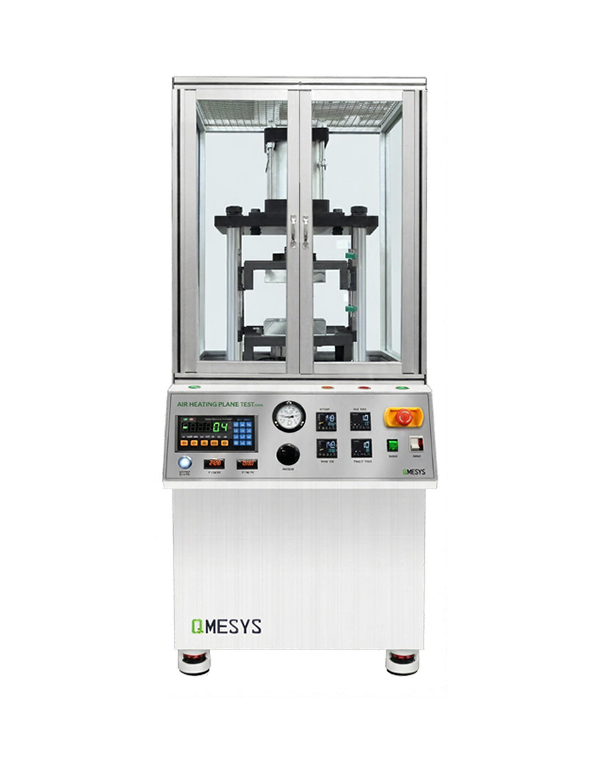
Equipment Structure and Specifications
The whole machine is designed around three requirements—"accurate pressure, stable temperature, no long-term drift"—with six key components delivering its consistency:
| Temperature range / accuracy | Room temp ~ 250°C, ±1°C |
| Max. pressure | 2.5 t (≈2,500 kgf, pneumatic system) |
| Platen size | 100 × 100 mm |
| Cooling method | Natural cooling |
| Dimensions | 650 (W) × 810 (D) × 1750 (H) mm |
| Safety certification | CE |
Note: The natural-cooling design avoids residual stress and secondary shrinkage in film specimens caused by rapid cooling, ensuring the post-hot-press state can go directly into subsequent performance evaluation.